Best Honeymoon Destinations in Africa
Last updated September 2026 · By the honeymoons.africa editorial team
Extraordinary places for the start of your forever.



Explore Africa’s Most Romantic Destinations
From white-sand beaches to epic safaris and mountain escapes.
Filter by region, or jump straight to a country.
Comparing budgets first? Use our African honeymoon cost guide to see realistic planning ranges across safari countries, islands and mixed itineraries.
Showing 24 destinations — all of Africa
 Zanzibar, TanzaniaTurquoise water, white sand and spice-island romance.From US$4,000 per couple
 KenyaMaasai Mara game drives, then barefoot on the Diani coast.From US$7,000 per couple
 TanzaniaSerengeti, Ngorongoro and the migration, then Zanzibar.From US$8,000 per couple
 SeychellesGranite coves, impossible water and complete privacy.From US$12,000 per couple
 MauritiusAll-inclusive lagoons and service that never slips.From US$4,500 per couple
 RwandaGorilla trekking in the Virungas, then still water at Lake Kivu.From US$12,000 per couple
 UgandaThe same gorillas as Rwanda, at half the permit price.From US$8,000 per couple
 MadagascarLemurs, baobabs and beaches with nobody else on them.From US$8,000 per couple
 MalawiA freshwater beach honeymoon, at a fraction of the cost.From US$4,000 per couple
 South AfricaCape Town, the winelands and malaria-free Big Five.From US$7,000 per couple
 BotswanaThe Okavango Delta — Africa’s most exclusive safari.From US$14,000 per couple
 NamibiaSossusvlei dunes and desert silence. Superb value.From US$6,000 per couple
 MozambiqueBazaruto and the Quirimbas. Barefoot, remote, uncrowded.From US$8,000 per couple
 ZambiaVictoria Falls, then walking safaris in South Luangwa.From US$10,000 per couple
 ZimbabweThe better side of the Falls, plus Hwange and Mana Pools.From US$9,000 per couple
 MoroccoRiads, Sahara camps and the Atlas. Three hours from Europe.From US$4,000 per couple
 EgyptA Nile dahabiya, then Red Sea reefs off El Gouna.From US$6,000 per couple
 Cape VerdeAtlantic islands, year-round sun and a six-hour flight from Europe.From US$4,000 per couple
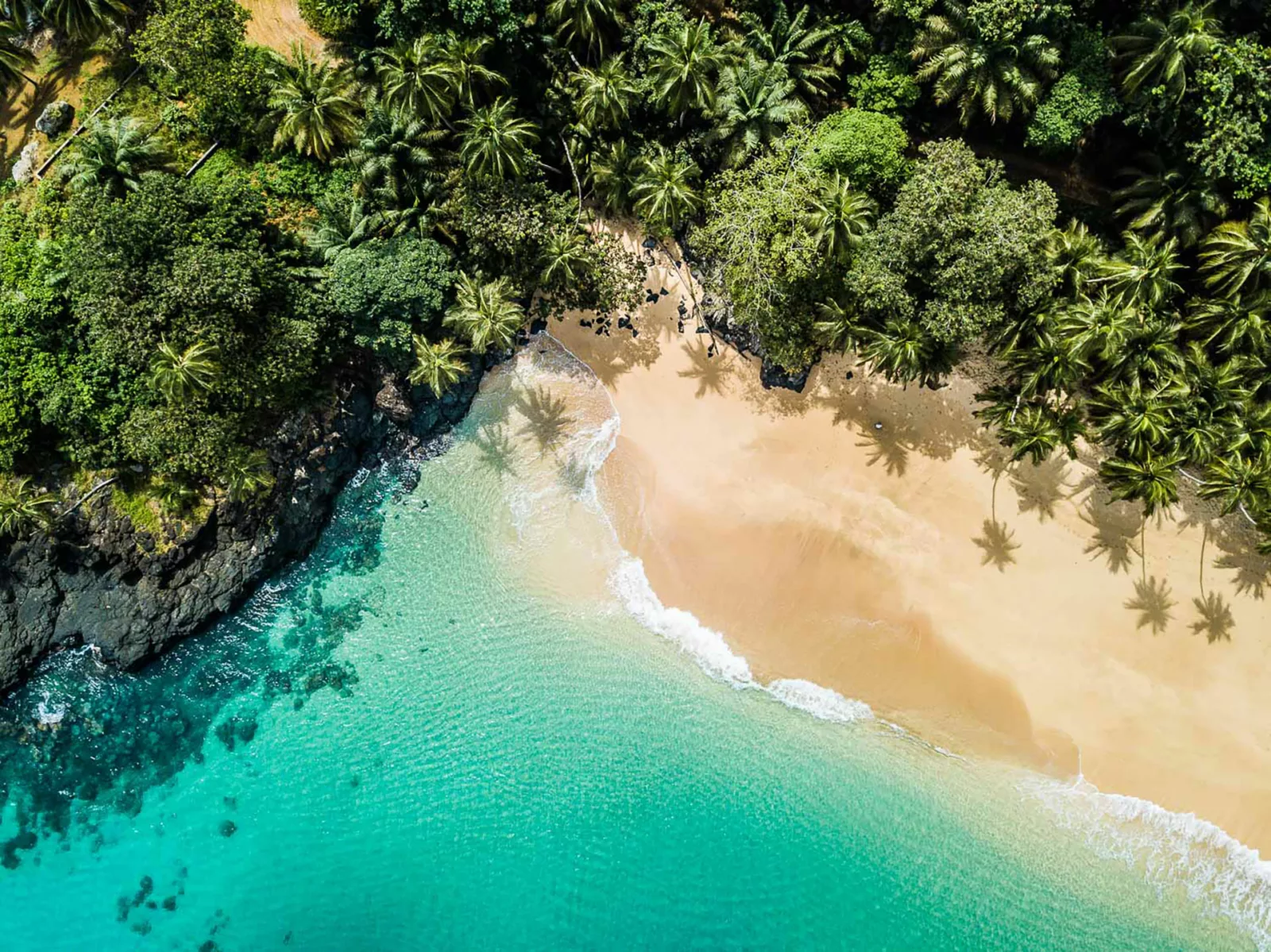 São Tomé & PríncipeRainforest, cacao estates and tiny Príncipe beaches almost to yourselves.Explore the honeymoon guide →
Destination photography via Unsplash.
Destination Questions
The things couples ask us most, answered honestly — pick a region above and these change with it.
What is the best honeymoon destination in Africa?
There is no single answer, but Tanzania paired with Zanzibar is the most popular choice for good reason: world-class safari in the Serengeti and Ngorongoro, then a 90-minute flight to genuinely excellent beaches, all within one country and one visa. If budget is the priority, Namibia and Zanzibar deliver the most per pound spent. If you want the most beautiful beaches on earth and money is not the constraint, Seychelles. For a first trip to Africa with short flights, familiar infrastructure and no malaria tablets, South Africa.
Can we combine two countries on one honeymoon?
Yes, and many couples do. The combinations that work well logistically are Kenya with Tanzania, Tanzania with Zanzibar (same country), South Africa with Mozambique or Zimbabwe, Botswana with Victoria Falls in Zambia or Zimbabwe, Zambia with Malawi, and Rwanda with Kenya. What to avoid is more than two countries in under fourteen nights — internal flights in Africa are expensive and often involve backtracking through a hub, so a third country can cost you two full days of travel.
Which African honeymoon destination is cheapest?
Morocco and Malawi are the least expensive overall, and Zanzibar offers the best value beach in Africa. For safari specifically, Namibia and Uganda cost substantially less than Botswana or Kenya’s private conservancies for a comparable experience. As a rough guide, a twelve-night honeymoon in Morocco or Malawi can be done from around US$4,000 to US$5,000 per couple including flights, while the same duration in Botswana rarely starts below US$14,000.
Where can we honeymoon in Africa without malaria risk?
Several excellent options are malaria-free or very low risk: the Eastern Cape and Waterberg reserves in South Africa, Cape Town and the winelands, most of Namibia including Sossusvlei and the Namib, Seychelles, Mauritius, and Morocco. This matters to some couples more than others, and it is worth raising with a travel clinic rather than deciding from a website — risk varies by season as well as location.
Which region of Africa should we choose?
East Africa if you want the iconic safari and an island beach in the same trip. Southern Africa if you want variety in one country, malaria-free options, or the Okavango Delta. North Africa if you have ten days or fewer and are flying from Europe. West and Central Africa if seeing almost no other tourists matters more to you than polished infrastructure. Use the region tabs above — the questions here change to match.
How far ahead should we book an African honeymoon?
Nine to twelve months for July–October or Christmas, which is when the good camps and the small island lodges fill first. Gorilla permits in Rwanda and Uganda are the tightest of all — six to twelve months. Outside peak season, four to six months is usually comfortable. If your dates are fixed by the wedding, start earlier rather than later; the constraint is almost never flights, it is the eight-room lodge you actually wanted.
When is the best time for an East African honeymoon?
June to October is the dry season: the best game viewing, the clearest skies, and the wildebeest river crossings in the Maasai Mara run roughly July to October. It is also the most expensive and the busiest. January and February are a strong second choice — calving season in the southern Serengeti, and excellent weather on the coast. March to May is the long rains: greenest, cheapest, and some camps close. Zanzibar, Seychelles and Mauritius are driest June to October and December to February.
Can we do safari and beach in one East African trip?
This is what the region does better than anywhere else. The standard shape is seven nights on safari and five on the beach. Serengeti or Ngorongoro to Zanzibar is a 90-minute flight inside one country and one visa. Maasai Mara to Diani on Kenya’s south coast is similar. Both give you the two halves of a honeymoon — early mornings and adrenaline first, then nothing to do at all — without a long-haul leg in the middle.
How much does an East Africa honeymoon cost?
For twelve nights per couple including flights from Europe: Zanzibar or Malawi from around US$4,000; Kenya or Tanzania safari-and-beach from about US$9,000; the same trip in a private conservancy or a high-season Serengeti camp runs to US$18,000 and beyond. Seychelles starts near US$12,000. The single biggest lever is season — the identical camp can cost 40% less in April than in August.
Is gorilla trekking worth it on a honeymoon?
Most couples who do it say it was the best hour of the trip. Permits are around US$1,500 per person in Rwanda and US$800 in Uganda, and buy you one hour with a habituated family. The trek itself can be one hour or five, at altitude, often in mud — reasonable fitness helps and porters are worth hiring. Uganda gives you a very similar experience for less money, at the cost of a longer drive from the airport. Neither is a good fit if either of you dislikes steep, wet walking.
Do we need malaria tablets in East Africa?
For mainland Kenya, Tanzania, Uganda, Rwanda, Malawi, Madagascar and Zanzibar, yes — take advice from a travel clinic well before you go. Seychelles and Mauritius are malaria-free, which is why they pair so well as the second half of a trip if this concerns you. Risk varies by altitude and season as well as by country; Nairobi and the Ngorongoro highlands, for example, are much lower risk than the coast.
When is the best time to honeymoon in Southern Africa?
It depends which half you care about. For safari, May to September — dry winter, thin bush, animals concentrated at water, and the lowest malaria risk of the year. For Cape Town, the winelands and the coast, November to March, which is their summer. If you want both in one trip, October is the compromise: hot in the bush, superb game viewing, and Cape Town already warming up. Victoria Falls is at its most dramatic February to May and at its thinnest September to December.
Which Southern African honeymoon is malaria-free?
This is the region’s quiet advantage. The Eastern Cape and Waterberg reserves in South Africa, Madikwe, Cape Town and the winelands, and almost all of Namibia including Sossusvlei and the Namib are malaria-free or negligible risk. You can build a full Big Five plus beach plus wine honeymoon in South Africa without a single tablet. Northern Botswana, the Zambezi valley and coastal Mozambique are not malaria-free.
Can we self-drive, or do we have to fly between lodges?
South Africa and Namibia are two of the easiest self-drive countries anywhere — good roads, clear signage, and the drive itself is part of the trip. The Garden Route and the Namibian desert circuit are made for it. Botswana’s Okavango Delta and Zambia’s South Luangwa are fly-in by light aircraft, which is expensive but genuinely spectacular and saves days. Many couples mix the two: self-drive one leg, fly the remote one.
Botswana or South Africa for our safari?
Botswana for exclusivity. The Okavango Delta limits bed numbers, so you can go a full day without seeing another vehicle, and water-based game viewing by mokoro is unlike anywhere else — but it rarely starts below US$14,000 per couple. South Africa for variety and value: Big Five reserves, Cape Town, the winelands and the coast in one trip, malaria-free options throughout, more direct flights, from around US$7,000. Neither is a compromise; they are simply different trips.
Victoria Falls — the Zambia side or the Zimbabwe side?
Zimbabwe has roughly three-quarters of the falls frontage and the classic face-on views, so if you only see one side, see that one. Zambia gives you Livingstone Island and Devil’s Pool at low water (roughly August to December), which is the photograph everyone recognises. The border crossing takes minutes and a KAZA UniVisa covers both, so most couples simply do both in a day and stop arguing about it.
When is the best time to honeymoon in North Africa?
March to May and September to November. Spring and autumn give you warm days, cool evenings and the Sahara at its most comfortable. Avoid July and August inland — Marrakech, Fes and Luxor regularly pass 40°C and the Sahara camps are unpleasant. December to February is mild and quiet on the coast but genuinely cold in the Atlas and in the desert at night, which some couples love and others do not.
Is Morocco a good honeymoon destination?
It is one of the best value honeymoons anywhere, and only three to four hours from most of Europe. The classic shape is a riad in Marrakech or Fes, two nights in a luxury desert camp at Erg Chebbi, a stretch in the Atlas mountains, and finishing on the coast at Essaouira. Riads are small, private courtyard houses — often eight rooms or fewer — which suits honeymooners far better than a large resort. From around US$4,000 per couple for twelve nights.
What can we do in Egypt on a honeymoon?
A dahabiya — a small sailing boat with six to ten cabins — between Luxor and Aswan, rather than a large cruise ship. It stops where the big boats cannot, and evenings on deck are as romantic as anything in Africa. Pair it with the Red Sea at El Gouna or Marsa Alam for diving and beach time. Egypt is malaria-free, flights are short from Europe, and the cost sits well below an East African safari.
Will we be comfortable as a couple in North Africa?
Yes. Morocco, Egypt and Tunisia all handle honeymooners routinely and hotels are relaxed about it. Dress is a courtesy question rather than a rule: covering shoulders and knees in medinas, mosques and smaller towns is appreciated and makes you less conspicuous. Resorts, riads and Red Sea hotels are entirely relaxed. Alcohol is available in hotels and licensed restaurants but not everywhere, which is worth knowing before you plan a wine-led trip.
Is West Africa realistic for a honeymoon?
For the right couple, yes — but be honest with yourselves about what you want. There is very little safari-lodge luxury here. What there is instead: Cape Verde’s Atlantic islands, six hours from Europe with year-round sun and proper resorts; Senegal’s Sine-Saloum lagoons and the music of Dakar; Ghana’s rainforest canopy walks, Cape Coast history and long, genuinely empty beaches. If the appeal of a place is partly that nobody you know has been, this is your region.
When should we go to West Africa?
November to May is the dry season on the mainland and the right window for Senegal and Ghana — the rains from June to October make roads hard and humidity heavy. Cape Verde works year round, with the caveat that December to March is the windy season, which is superb if you want to kitesurf and less so if you want a flat, still beach.
What does a West African honeymoon cost?
Cape Verde is the value story: from roughly US$3,500 to US$6,000 per couple for ten to twelve nights including flights from Europe, comparable to the Canaries but far less familiar. Senegal and Ghana sit around US$5,000 to US$9,000 depending on how much you fly internally and how remote you go. All well below an East or Southern African safari.
Do you have guides for these countries yet?
Not yet — we would rather publish nothing than publish something thin. Full guides for Cape Verde, Senegal and Ghana are in progress. In the meantime, tell us which one you are thinking about and we will introduce you to a specialist who works there properly. That costs you nothing and does not depend on the guide being finished.
Is Central Africa realistic for a honeymoon?
It is a second or third trip to Africa, not a first. Logistics are fly-in, lodges are few, and the cost per night is high for the level of polish you get. What you buy with that is genuine solitude — on São Tomé and Príncipe you can have a beach entirely to yourselves, and at Odzala you may be the only guests in camp. If the idea of that matters more to you than a spa and a wine list, it is extraordinary.
Lowland gorillas in Congo, or mountain gorillas in Rwanda?
Different animals and very different experiences. Mountain gorillas in Rwanda and Uganda are the famous ones: well-organised, reliable sightings, and busier. Western lowland gorillas at Odzala-Kokoua in the Republic of Congo live in dense rainforest and open forest clearings called bais, and you will likely share the experience with nobody. Odzala costs more per night and takes longer to reach. Rwanda is the safer choice; Congo is the braver one.
What makes São Tomé & Príncipe special?
Two volcanic islands off Gabon where old cocoa plantation houses have been turned into a small number of very good lodges. Rainforest runs down to empty beaches, there is almost no tourism infrastructure and almost no tourists, and Príncipe in particular is a UNESCO biosphere reserve with a handful of rooms on the whole island. Portuguese-speaking, warm year round, and about as far from a resort honeymoon as it is possible to get.
When is the best time to visit Central Africa?
June to September is the main dry season across the Congo Basin and the most comfortable window for forest walking and gorilla tracking. December to February gives a shorter dry spell. São Tomé and Príncipe are warm all year, driest June to September; Gabon’s Loango is best May to September, when whales pass the coast and the beach-forest wildlife is easiest to see.
Africa by Region
Most couples pick one safari destination and one beach. These pairings connect without wasting days in transit.
- East Africa — the classic safari, plus the islandsThe Serengeti, the Maasai Mara and the wildebeest migration, then a short hop to Zanzibar, Seychelles, Mauritius or Madagascar. The best safari-and-beach combinations on the continent are all here, and Zanzibar is 90 minutes from the Serengeti.
- Southern Africa — wilderness, wine and the FallsCape Town and the winelands, the Okavango Delta, Sossusvlei’s dunes, Victoria Falls and the Mozambican archipelagos. Malaria-free options are easiest to find here, and self-drive works in a way it does not further north.
- North Africa — short flights, big contrastThree to four hours from Europe. Riads in Marrakech, Sahara camps, the Atlas mountains, and in Egypt a Nile dahabiya followed by Red Sea diving. The cheapest way to have a genuinely exotic honeymoon.
- West & Central Africa — for couples who want no one else thereCape Verde’s Atlantic islands, São Tomé’s plantation lodges, and lowland gorillas in Odzala. Harder to arrange and thinner on luxury infrastructure — but nobody you know will have been. Guides for these are in progress; ask us in the meantime.
Not sure where to go?
Tell us what you want the trip to feel like and your budget. We’ll come back with two or three destinations that genuinely fit — and introduce you to the specialists who know them best.
Get Personalized Recommendations
Inspiration for your
perfect honeymoon
Get romantic ideas, seasonal timing tips and honest destination news straight to your inbox.