Honeymoon in Namibia
Last updated September 2026 · By the honeymoons.africa editorial team
Red dunes, empty horizons and the deepest silence in Africa. The best-value wilderness honeymoon on the continent — and the most unusual.
Namibia is the outlier on this site, and the one couples are most surprised by. It is not really a safari destination in the East African sense — you do not come for dense game. You come for landscape: 300-metre apricot dunes at Sossusvlei, a coastline where the desert meets cold Atlantic fog, canyons, and skies so dark the Milky Way casts a shadow. Namibia has one of the lowest population densities on earth, and you feel it.
Budget US$6,000 to US$16,000 per couple for twelve nights including flights. It offers, per pound spent, more genuine wilderness than anywhere else in Africa — largely because self-drive is not just possible but pleasant, which removes the expensive light-aircraft transfers that dominate Botswana and East African budgets.
Where to go
Sossusvlei and the Namib
The image that sells Namibia: enormous rust-red dunes, and at Deadvlei a white clay pan studded with 900-year-old blackened camel thorn trees. Climb Dune 45 or Big Daddy before sunrise — the light in the first hour is extraordinary, and the sand is unwalkable by ten. Two nights.
Hot air balloon flights over the Namib at dawn run around US$500 per person and are, in our view, more spectacular than the Serengeti equivalent.
Swakopmund and the Skeleton Coast
A German colonial town of pastel buildings and coffee shops, wedged between dunes and a cold, foggy Atlantic. It is odd and rather charming. North of it the Skeleton Coast is one of the most desolate places on earth — shipwrecks, seal colonies, desert-adapted lions. The far north is fly-in only and expensive; the southern section is drivable. Two nights.
Damaraland
Our pick for the most memorable nights in Namibia. Vast granite and ochre terrain, ancient rock engravings at Twyfelfontein, and desert-adapted elephant and black rhino that survive in country that looks incapable of supporting anything. The camps here are small and the sense of remoteness is total. Two or three nights.
Etosha National Park
The game-viewing half. A huge salt pan surrounded by waterholes, and in the dry season the animals must come to them — so rather than searching, you park and wait, and everything arrives. Several camps have floodlit waterholes you can watch from bed. Excellent for black rhino. Three nights.
The Kalahari and Fish River Canyon
If you have longer, the southern Kalahari has red dunes and superb stargazing, and Fish River Canyon is the second largest in the world. Both work well as first or last stops.
Best time to go
Month-by-month detail: see our best time for a Namibia honeymoon guide.
| Period | Conditions | Verdict |
|---|---|---|
| May – Jun | Dry, mild days, cold nights and mornings. Landscape still has some green. | Best overall |
| Jul – Aug | Peak season. Dry, cool, very good game at Etosha waterholes. Cold at dawn. | Excellent, busiest |
| Sep – Oct | Hot and very dry. Best Etosha game viewing of the year as water sources vanish. | Best for wildlife |
| Nov – Dec | Hot, first rains possible, dramatic skies, quiet, cheaper. | Good value |
| Jan – Apr | Green season. Hot, occasional heavy rain, some gravel roads affected. Landscape transformed and beautiful. | Best value; photogenic |
May, June, September and October are the strongest months. Note that Namibian winter nights genuinely get close to freezing in the desert — couples routinely arrive with only summer clothes and regret it.
What it costs
Full budget breakdown: see our Namibia honeymoon cost guide for 7, 10 and 14 night budgets.
| Style | Per couple, 12 nights | What it buys |
|---|---|---|
| Self-drive | US$6,000 – 9,000 | 4×4 hire, good guesthouses and mid-range lodges, flights from Europe. Genuinely excellent, and how most Namibians would tell you to travel. |
| Premium self-drive | US$11,000 – 16,000 | The best lodges at each stop, some guided days, a balloon flight, a scenic flight over the Skeleton Coast. |
| Fly-in | US$20,000 – 35,000+ | Light aircraft between remote camps, private guide, exclusive Skeleton Coast and Kaokoland concessions. No driving at all. |
Lodges typically run US$150–400 per person per night, a fraction of Botswana or Kenya, and many of the best are small owner-run places rather than corporate lodges. 4×4 hire with rooftop or standard accommodation runs around US$90–160 per day.
Namibia rewards a well-sequenced route and punishes a badly planned one — distances are long and some stretches are far more interesting than others. Send one brief and specialists will build it. Free, no obligation.
Get Namibia proposalsSample itineraries
Twelve nights, self-drive (from about US$7,500 per couple)
- Nights 1–2: Windhoek and the Kalahari.
- Nights 3–4: Sossusvlei — sunrise at Deadvlei, balloon flight.
- Nights 5–6: Swakopmund — the coast, seals, sandboarding.
- Nights 7–9: Damaraland — desert elephant, rock art.
- Nights 10–12: Etosha — waterhole game viewing.
Nine nights, the highlights (from about US$6,000)
- Nights 1–3: Sossusvlei.
- Nights 4–5: Swakopmund.
- Nights 6–9: Etosha.
Fourteen nights, Namibia and Cape Town (from about US$12,000)
- Nights 1–9: Namibia self-drive as above, shortened.
- Nights 10–14: Fly to Cape Town for the city, winelands and a proper rest.
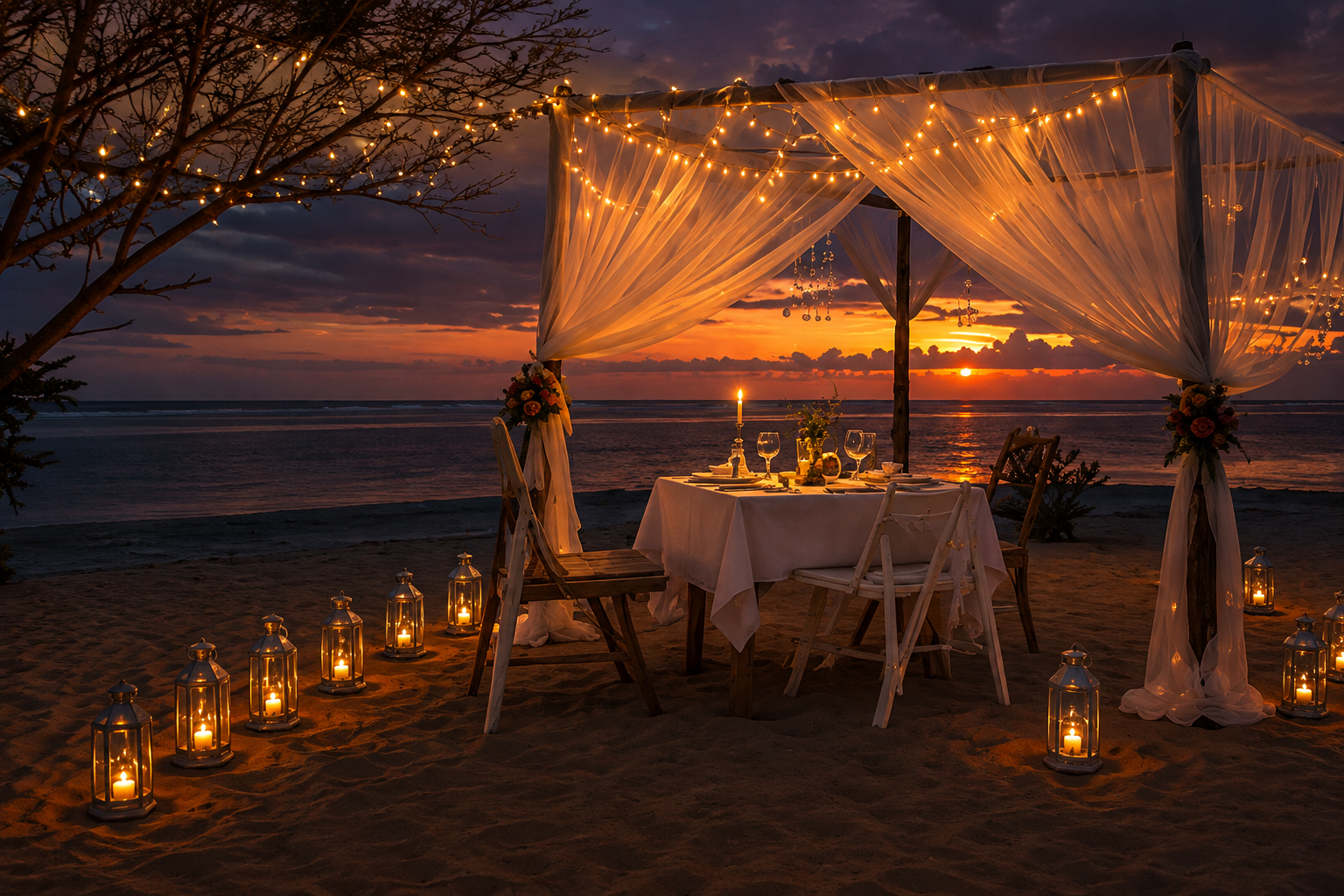
That last one solves Namibia’s only real weakness as a honeymoon: there is no beach half. Pairing it with Cape Town or Mauritius gives you the contrast most couples want.
Practical details
Getting there
Windhoek’s Hosea Kutako International has direct flights from Frankfurt and connections via Johannesburg, Cape Town, Doha and Addis Ababa. There is no direct service from the UK; most British couples route via Johannesburg or Frankfurt.
Visas and entry
Namibia introduced a visa-on-arrival fee for many previously visa-exempt nationalities in 2025, including UK, EU, US, Canadian and Australian passport holders. It is straightforward and payable on arrival, but it is new and catches people out. Check the current position on the official Namibian immigration site before you travel, as the implementation has been adjusted more than once.
Health
Most of Namibia including Sossusvlei, the Namib, Damaraland and the coast is malaria-free. The far north around Etosha and the Caprivi Strip carries a seasonal risk, mainly in the wet months from November to June. This makes Namibia a strong choice for couples who would rather avoid antimalarials.
Driving
On the left. Main routes are tarred; most scenic routes are well-maintained gravel. A 4×4 is recommended, not for technical terrain but for clearance and tyre resilience — punctures are the single most common problem, so take two spares and know how to change one. Do not drive at night: wildlife on unlit gravel roads is a genuine hazard. Fuel stations can be 200km apart, so fill up whenever you can.
Worth asking for
- A dawn balloon flight over the Namib — around US$500 per person, and the best money you will spend in Namibia.
- A scenic flight over the Skeleton Coast from Swakopmund — shipwrecks and seal colonies from the air.
- A lodge with a private plunge pool at Sossusvlei — afternoons are too hot to do anything else.
- An astronomy night. Several lodges have serious telescopes and guides; Namibia has some of the clearest night skies on the planet.
- Two spare tyres if self-driving, and confirm the hire company’s puncture policy in writing.
- Warm layers for May to August — desert nights approach freezing.
Namibia Honeymoon Questions
How much does a Namibia honeymoon cost?
Between US$6,000 and US$16,000 per couple for twelve nights including flights. A self-drive trip with good lodges starts around US$6,000, which makes Namibia the best-value wilderness honeymoon in Africa. A premium self-drive with the best lodges and a balloon flight runs US$11,000 to US$16,000. A fly-in itinerary with light aircraft between remote camps costs US$20,000 to US$35,000 — roughly double, because you are removing the driving.
Is Namibia good for a honeymoon?
It is, for a particular kind of couple. Namibia offers extraordinary landscape, genuine solitude and some of the darkest night skies on earth, at a fraction of Botswana’s cost. What it does not offer is dense big-game viewing in the East African sense, or a beach. It also involves substantial driving — typically 1,500 to 2,500km over two weeks. Couples who like road trips and empty spaces love it; couples who want to arrive somewhere and not move should look at Zanzibar or Mauritius instead.
Should we self-drive in Namibia?
For most couples, yes. Roads are good, main routes are tarred and scenic routes are well-maintained gravel, and self-driving roughly halves the cost of the trip by removing expensive light-aircraft transfers. Take a 4×4 for clearance and tyre resilience, carry two spare tyres, and never drive at night — wildlife on unlit gravel roads is a real hazard. Punctures are the most common problem, so confirm the hire company’s policy in writing.
Is Namibia malaria-free?
Mostly. Sossusvlei, the Namib desert, Damaraland, Swakopmund and the entire coast are malaria-free. The far north around Etosha and the Caprivi Strip carries a seasonal risk, mainly during the wet months from November to June. This makes Namibia one of the better options for couples who would rather not take antimalarials, though you should confirm with a travel clinic based on your specific route and dates.
When is the best time to visit Namibia?
May and June, or September and October. May and June give mild dry days with some green still in the landscape. September and October have the best wildlife viewing at Etosha, as water sources vanish and animals concentrate at the waterholes, though days are very hot. Be aware that desert nights from May to August approach freezing, and couples routinely arrive with only summer clothes.
Do we need a visa for Namibia?
Namibia introduced a visa-on-arrival fee in 2025 for many previously visa-exempt nationalities, including UK, EU, US, Canadian and Australian passport holders. The process is straightforward and payable on arrival, but it is a recent change that catches travellers out. Check the official Namibian immigration site close to your departure, as the implementation has been adjusted more than once.
What can we combine Namibia with?
Cape Town is the natural pairing — a short flight, and it gives you the city, winelands and coastline that Namibia lacks. Namibia has no beach half of its own; the Atlantic coast is cold and foggy rather than swimmable. Botswana and Victoria Falls also combine well for a longer wilderness-focused trip, and Mauritius works if you want a proper beach week afterwards.
Start Planning Your Dream Honeymoon
Share a few details and we’ll introduce you to specialists who know your destination properly. Free, and no obligation.