The Honeymoon Conversations · Exclusive written interview · Chole Island, Tanzania
Inside Chole Mjini: A Honeymoon in the Trees
Sunset dhows, treehouse plunge pools and candlelit dinners in centuries-old ruins. Founder Anne K. de Villiers reveals why a week here can mean more than any traditional island honeymoon.
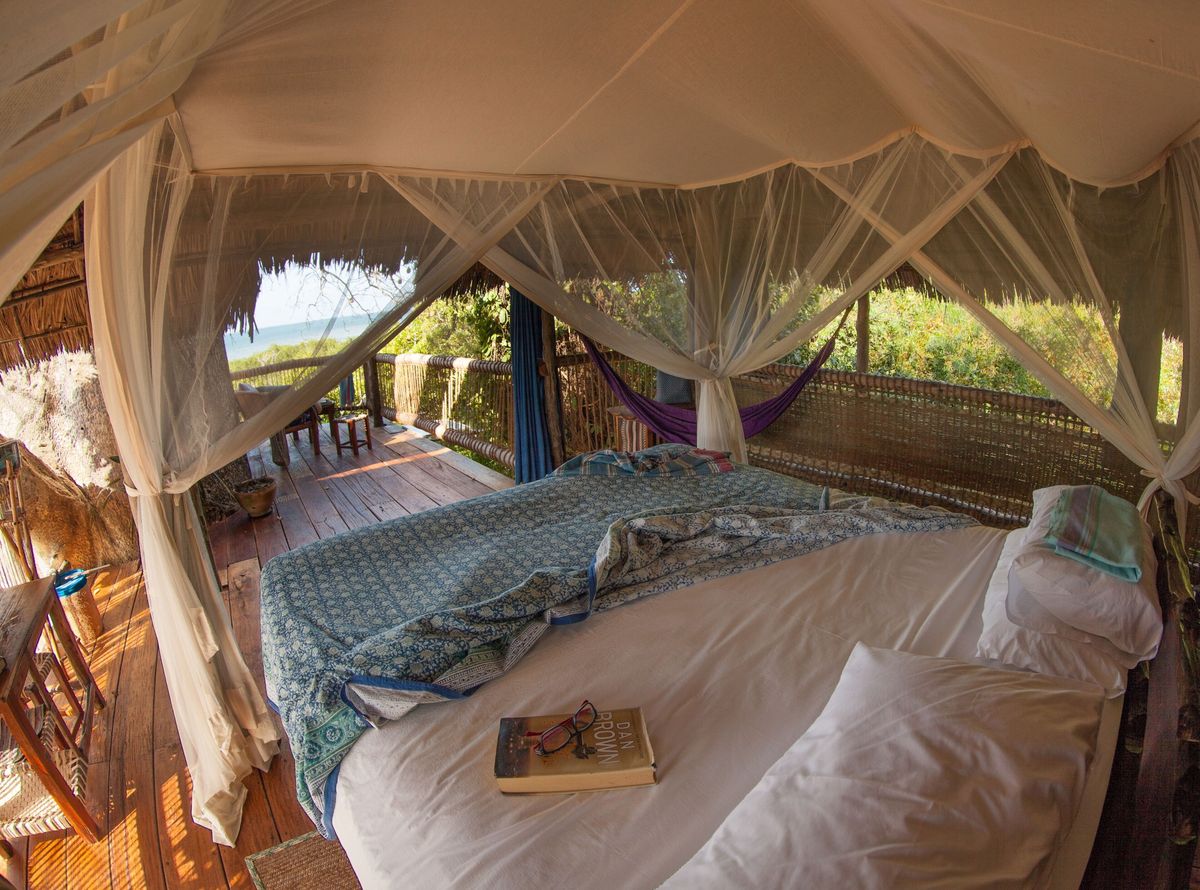
On tiny Chole Island in Tanzania’s Mafia Island Marine Park, Chole Mjini is built around baobabs and old Swahili ruins — six individual treehouses and one ground house where morning coffee arrives by pulley.
In this exclusive written interview for honeymoons.africa, Anne K. de Villiers, Owner, Manager & Founder, explains what a honeymoon here is really like: the exact treehouses she recommends, quieter months, meals and booking arrangements, and the personal stories that make the lodge memorable. Her written answers were received on 4 November 2026.
“We call it barefoot luxury, though perhaps it is more about a feeling: slowing down, breathing deeply and rediscovering each other.”— Anne K. de Villiers, Chole Mjini
01 · A different kind of island
Why Chole Mjini feels different
A treehouse stay within a living Swahili island community, not an enclosed beach resort.
What makes your hotel, and its surrounding destination, a special place for a honeymoon?
Anne K. de Villiers answers
Chole Mjini is a little different from the usual honeymoon hideaway. Our seven handcrafted houses – six treehouses and one ground house – are tucked among ancient baobabs, tamarind trees, historic ruins and the shoreline of Chole Island, in Tanzania’s Mafia Island Marine Park.
Each house has its own personality, built by local craftsmen and designed to bring you closer to nature. There is no air-conditioning by design: instead, you fall asleep to the sound of the tide and fruit bats in the trees, watch the stars from your bed, and wake to birdsong and morning tea or coffee gently sent up to your treehouse by pulley. Comfort is simple but thoughtful, and privacy comes naturally.
We call it barefoot luxury, though perhaps it is more about a feeling: slowing down, breathing deeply and rediscovering each other. The island has a way of working its magic.
There is plenty to explore together, too. We plan each day around the tides – a sunset dhow sail, snorkelling or diving on nearby reefs, a picnic on a sandbank that appears only at low tide, or a paddle through the mangroves. The lodge sits among the ruins of Chole, once Mafia’s most important town, while the older ruins of Kua lie across the channel on Juani Island, that can be visited on foot at low tide, or just a boat ride away.
Mafia is Tanzania’s quieter island, with a marine park at its heart and Swahili coastal life still very much alive. It is just a short flight from Dar es Salaam or Zanzibar, making it a wonderful ending to a safari or Kilimanjaro climb.
And a stay here is about more than romance. Founded in 1994 in partnership with Chole village, the lodge has at least 90% of its team drawn from the island. Couples can snorkel or dive the coral nurseries of The Ropes of Hope, where local fishermen are helping restore the reef. It is a honeymoon with a little more meaning.
02 · Where to sleep
Which treehouse would Anne choose?
Nne comes first, but the alternatives are quite different. Every house is booked by its own name.
If you were booking your own honeymoon here, which room or suite would you choose, and why?
Anne K. de Villiers answers
We would choose Treehouse Nne. It is one of our three houses with a private plunge pool, and everything is elevated: the toilet, twin sinks and open-air shower are all up in the treehouse. You could happily spend your entire stay without coming down to ground level!
Nne has its own baobab and looks out towards the open ocean. Above it is a wonderful open-sided tea house, with 360-degree views and spectacular sunsets. Imagine showering beside your plunge pool as fireflies appear, or lying beneath the stars with the sea all around you. It is one of our most popular houses, and plunge-pool houses are reserved for guests aged ten and above.
Treehouse Saba is another favourite for couples seeking seclusion. Built around two flamboyant trees among historic ruins, it sits right on the beach, with a private plunge pool and a rare view across the water to Mafia Island. In the mornings, you can watch fishermen setting out to sea; at night, the island’s lights twinkle across the bay.
Treehouse Tatu, our “house on the rocks”, is closest to the ocean. Reached through a tunnel of foliage, its plunge pool sits on a private sun deck above the beach.
And then there is Treehouse Moja, wrapped around the granddaddy of our baobabs on the shoreline. It has no plunge pool, but for us it may be the most romantic of all. The rising sun or moon lights up its deck, and the hanging seed pods invite dreams and wishes. Guests have been known to dance in the rain up there, celebrating nature in the most joyful way.
Our recommendation: Treehouse Nne, with Saba, Tatu or Moja as equally enchanting alternatives. Each house is booked by its own name.
03 · Atmosphere, season & duration
When to go — and how long to linger
The tides are part of the itinerary; your room, weather and preferred pace matter more than a rigid schedule.
What atmosphere should honeymooners expect: quiet and secluded, lively and social, or a mixture?
Anne K. de Villiers answers
A little of both – and entirely up to the couple.
With just seven houses scattered through a mature garden beside the sea, Chole Mjini is peaceful and intimate. Thirty years of protecting the gardens have created something close to a botanical garden, full of ancient trees and birdsong. At night, lanterns replace bright lights, allowing fireflies, genets and civets to carry on their lives undisturbed.
There is no fixed programme. You can be as adventurous or as relaxed as you wish. Each evening, we plan the next day together, or you can simply leave it to the tides and see where the day takes you.
At dinner, you choose whether to join the shared table and swap stories with fellow travellers, or enjoy a candlelit table just for two. Before dinner, our Red Herring bar is the perfect place for a sunset drink, facing Mafia Island across the channel.
Chole is also a living island, not a resort behind fences. Fishermen set out from the beach each morning, and village life continues around us. Crabs, geckos and birds share our gardens. For us, this connection to nature and local life is part of the magic.
A few days are rarely enough. There is so much to discover – but equally, there is nothing wrong with spending an entire afternoon in your treehouse.
Which months would you personally choose for a honeymoon here, and why? What would couples gain, or need to accept, by visiting at other times?
Anne K. de Villiers answers
For a honeymoon, we would choose October or early November, or February. These months offer a lovely balance of calmer seas, good diving conditions and the chance to encounter whale sharks, whose season is generally most reliable from September to February. They also avoid the busiest Christmas and New Year weeks.
We are open from mid-June to the end of March, and each season has its own charm:
• June to September: The kusi wind brings cooler, breezier days, particularly in July and August. This is also turtle-hatching season on Juani Island, and a wonderful time to combine Mafia with a safari. Cooler nights are rather lovely for honeymoon snuggling.
• Late November to February: The kaskazi wind brings warmer, more humid weather and generally calmer seas.
• 20 December to 6 January: Our busiest period, when families, couples and solo travellers come together for the holidays.
• June, September and March: Quieter months with lower rates. The long rains begin around mid-March, and we close from 31 March to 15 June.
Whale sharks are present in Mafia’s waters throughout the year, although their seasonal movements are becoming less predictable. Diving is possible year-round, too.
There is no truly bad time for a honeymoon here – just different moods of the island.
How many nights would you recommend for couples to enjoy your hotel and the surrounding area without feeling rushed?
Anne K. de Villiers answers
Our minimum stay is three nights, but for a honeymoon we would recommend at least a week.
The island has its own rhythm, dictated by the tides. A sandbank may appear for only a few hours at low tide, the Blue Lagoon is reached at high tide, and dive sites change with the conditions. Staying longer means you can enjoy everything without feeling that you are working through a checklist.
If swimming with whale sharks is on your wish list, a few extra days are worthwhile. Every encounter is different, and having time for more than one outing makes the experience all the more rewarding.
A week also gives you time to do absolutely nothing: read on your deck, get to know the village and our team, or simply let the island work its magic. Many guests end up extending their stay. There is something about Chole that makes leaving rather difficult.
04 · True stories
A proposal in the Blue Lagoon, and other honeymoon memories
Anne shares real moments the team has helped create for couples.
Can you share a memorable honeymoon story that captures the spirit of your hotel, without identifying the couple?
Anne K. de Villiers answers
Where do we begin? Honeymoons at Chole Mjini have given us some wonderful stories.
A ring in the Blue Lagoon
One guest arrived with a secret plan to propose, hiding a ring in a box for his partner to discover while snorkelling in the Blue Lagoon. We helped set it up – and thankfully, the ring was found! She said yes, and the rest of their stay was filled with private dinners, and cosy adventures.
A secret wedding
Another couple arrived to celebrate their wedding, without their families knowing. We arranged a sunset dhow sail, a sandbank picnic and dinner among the ruins, while their invited friends gradually joined and helped the secret unfold. It was a wonderfully intimate celebration.
A tug-of-war over a surname
One newlywed couple had a rather lively disagreement about whether she should take his surname. At their reception, a tug-of-war was organised to settle the matter. His friends joined her family’s side, pulled the rope across the winning line, and the choice was hers. He was mortified! After a little time to relax and talk, they reached a compromise: she would take his name, but choose their children’s names. They left ready for their happily ever after.
A pre-wedding honeymoon
A young couple came to Chole before their wedding, simply because it was the only time they could both take leave. They spent their days relaxing and preparing for the celebrations ahead, and left feeling peaceful, refreshed and ready to begin married life. Perhaps this is a new honeymoon tradition?
A coconut-frond hula skirt
And then there was the couple who requested a hula skirt and a frangipani lei. We made the skirt from coconut fronds, and they danced beneath the stars. Sometimes romance is wonderfully simple.
Each couple leaves a little piece of themselves here. We love that.
05 · Food, culture & romance
Swahili cooking, dhow sails and dinners under the stars
The interview explains where romance and everyday island life meet.
What local traditions, ingredients, art or experiences do you incorporate into a couple’s stay?
Anne K. de Villiers answers
Chole Mjini is deeply rooted in island life. Our cooks are from Chole and create daily menus around what the island grows and what the fishermen bring in: fresh seafood, prepared in the Swahili way with coconut milk and Indian spices.
The houses themselves are built using local materials and traditional hand tools – local timber, makuti palm-leaf roofing, reed mats and coconut rope. Even our boats are crafted by local boatbuilders.
There are also lovely traditions surrounding marriage. Young brides on the island are traditionally prepared for their honeymoon by other women, with local incense, known as udhi, and beads worn around the waist. Our housekeepers are delighted to share this tradition with honeymoon guests. We also offer a bottle of sparkling wine to mark the occasion.
Couples can immerse themselves in island life through a range of experiences:
• A sunset dhow sail: A romantic journey aboard a traditional wooden sailing boat.
• A Swahili cooking lesson: Learn to make chapati or fresh coconut milk, tui la nazi, over a traditional firewood fire.
• A craft lesson: Weave mikeka mats from ukindu fibre or make coconut-fibre rope, just as the rope that holds our treehouses together.
• A village walk: Explore Chole’s ruins, old mosque, plantations, small craft shops and local school with a member of our team.
• A baobab wish: Visit the baobab garden to make a sacred wish.
• A massage: Enjoy a relaxing treatment on the first floor of the Old Boma, a historic building restored by the lodge owners.
Chole is a conservative Muslim community, and we ask guests visiting the village to dress respectfully, covering shoulders and chest and wearing clothing below the knee. We also ask that permission be sought before photographing people. Within the lodge and on our boats, guests are welcome to dress as they please.
What is your favourite romantic dining experience here, and what should couples know about its setting, price and advance booking?
Anne K. de Villiers answers
At Chole Mjini, dinner is never quite in the same place twice. Our tables move around the lodge, creating a new setting each evening – among the old ruins, beneath the tamarind tree, on the jetty beside the mangroves, or tucked away in the gardens.
Two of our favourite settings are the jetty, where you dine beneath the stars with the sound of waves and a gentle sea breeze, and in the ruins of the old town, where fig roots embrace ancient stone walls and lanterns glow in the niches. Both are wonderfully atmospheric.
The evening begins with sunset drinks at the Red Herring bar, overlooking Mafia Island, or perhaps a cocktail beneath the stars at our Hanashi rooftop bar. Dinner is a three-course candlelit affair, usually at 20:00, though we are happy to adjust the time to suit you.
The food and price: All meals, tea, coffee and filtered water are included in your stay. Our menus are home-cooked, island-inspired and change daily with the catch. This is not fine dining or à la carte, but generous, authentic Swahili cooking that you won’t find anywhere else. Vegetarian, vegan and gluten-free diets are catered for. Bar drinks are charged separately and settled at the end of the stay.
Booking: No advance booking is needed. Each day we simply ask, after lunch, whether you would prefer the shared table or a private candlelit dinner for two.
For a daytime romantic escape, nothing quite beats a picnic on the Marimbani sandbank. Our boatmen set up a shaded canopy on your own temporary beach in the marine park. It is hard to imagine a more beautiful lunch spot.
06 · From the founder
Anne on hospitality, privacy and Chole’s people
A personal account of why the lodge exists and how its team looks after couples.
What inspired your career in hospitality, and which part of hosting honeymooners is most meaningful to you?
Anne K. de Villiers answers
Hospitality was never really the starting point. We fell in love with Chole and its people, and wanted to create something that would connect others to the island while helping its community flourish. The lodge grew from that idea, in partnership with the people who call Chole home.
What we have created is perhaps less a hotel than a magical place to reconnect – with nature, with your senses and, most importantly, with the person beside you. Guests often tell us how quickly they relax here, how the stresses of everyday life seem to melt away. After the excitement and chaos of a wedding, that is exactly what a honeymoon should offer.
Weddings are an important part of community life on Chole, and there is a genuine joy in celebrating a couple beginning their life together. We feel honoured when couples choose to spend their honeymoon with us, and even more so when they return for anniversaries. They become part of the Chole family.
What has working in hospitality taught you about giving couples privacy while still making them feel cared for?
Anne K. de Villiers answers
Every couple is different, and we have learnt that the best hospitality is often the kind you barely notice.
With only seven houses and a dedicated team, we can shape each stay around the couple rather than asking them to fit into a programme. Much of our care happens quietly: morning tea or coffee arrives by pulley, housekeeping works around your excursions, and a watchman looks after your house while you are away, stepping back when you return.
Each house has a whistle for calling assistance during the night, so couples can feel secure without compromising their privacy. Our team plans the following day with you each evening, taking into account the tides, weather and, just as importantly, how you feel. Or you can leave the day entirely free.
At dinner, you decide whether to join the shared table or dine privately by candlelight. We never want couples to feel they are being looked after at the expense of their solitude.
We are small enough to listen, flexible enough to adapt, and always delighted when we can help make a dream come true.
07 · Practical planning
How to plan a Chole Mjini honeymoon
Ready to compare Chole Mjini dates?
Explore the exact property listing on Expedia, or contact the lodge directly if you want a named treehouse, private dining or help with a special occasion.
Affiliate disclosure: Expedia links may earn honeymoons.africa a commission, at no extra cost to the reader. Exact room category, availability and rates must be confirmed before booking.
Make it part of an African honeymoon journey
Chole Mjini’s owners describe the island as a natural conclusion to a Tanzanian safari. See our Mafia Island honeymoon planning guide, the Tanzania destination hub and our guide to sunset dhow sailing.
Explore Mafia Island
Compare Chole Mjini with other small lodges, learn about whale-shark timing and understand the island’s flight connections.
Read the Mafia Island honeymoon guideMore from The Honeymoon Conversations
Meet other African hotel owners and managers who share first-hand advice for couples.
Browse more exclusive interviews
Start Planning Your Dream Honeymoon
Share a few details and we’ll introduce you to specialists who know your destination properly. Free, and no obligation.